
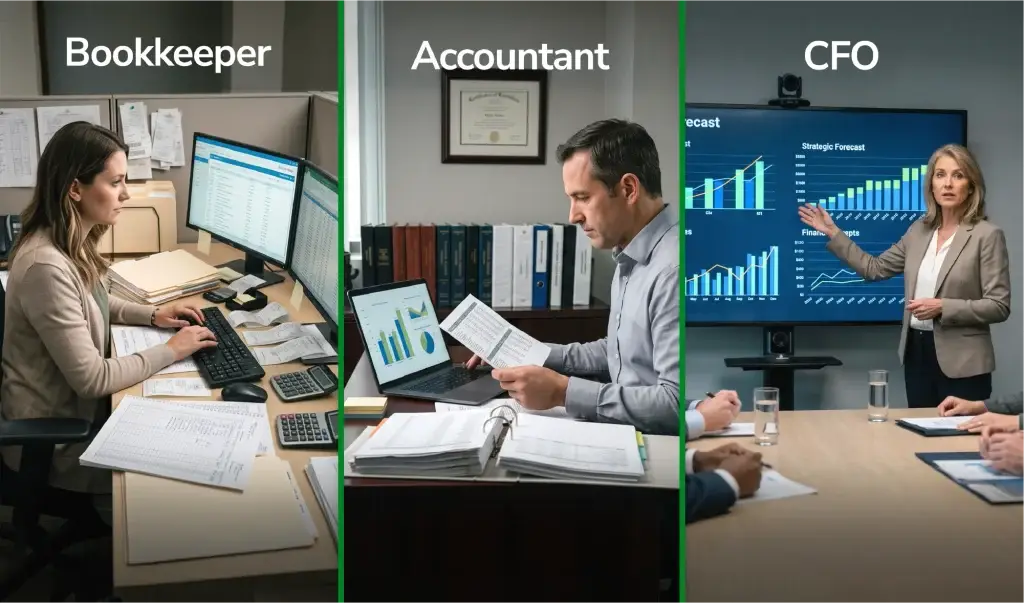
A bookkeeper records what happened, an accountant interprets it and files it, and a CFO uses it to decide what happens next. All three work from the same numbers, which is why the roles blur together and why small business owners often end up paying one of them to do another’s job.
This guide sets out what each role covers, what each typically costs, and which one your business needs at its current size.
The Short Version
What is the difference between a bookkeeper and an accountant? It comes down to recording versus interpreting. A bookkeeper keeps the day-to-day financial record complete and accurate. An accountant turns that record into adjusted financial statements, tax returns and tax advice. A CFO, who is usually part time in a small business, uses both to plan cash, pricing and growth.
| Factor | Bookkeeper | Accountant | CFO |
| Core question | What happened? | What does it mean, and what do we owe? | What should we do next? |
| Time frame | This week and last month | The year just closed | The months and years ahead |
| Main output | Reconciled books, monthly profit and loss and balance sheet | Adjusted financial statements, tax returns, tax plans | Budgets, cash forecasts, scenario models |
| License required | None | None to be called an accountant; a state license to use the CPA title or sign audit and review reports | None, though the role usually follows years of finance or accounting experience |
| Can represent you before the IRS | No | Yes, if a CPA, enrolled agent or attorney | Not part of the role |
| Median pay as an employee (BLS, May 2025) | $50,670 for bookkeeping, accounting and auditing clerks | $83,680 for accountants and auditors | No separate figure; $166,570 for financial managers |
| How small businesses usually get one | In-house or outsourced, monthly | Through an outside firm | Fractional, part-time |
Each role depends on the one before it. Accountants cannot file an accurate return from books nobody reconciled, and a CFO cannot forecast from numbers that are three months behind. If you are new to the first role, our guide to what is a bookkeeper covers what one does week to week.
The Bookkeeper: Recording What Happened
A bookkeeper owns the general ledger, the master record of every transaction. They categorize bank and card transactions, reconcile every account against its statement, enter bills, track customer invoices, record payroll from the payroll provider’s reports, and close the books each month.
Their work is judged on one test: do the books match reality, account by account, every month? A bookkeeper does not need a license, and the Bureau of Labor Statistics notes that certification is not usually required, so the quality of the work depends heavily on who reviews it.
Typical Scope and Cost
For a small business, the bookkeeper’s scope usually covers:
- Weekly categorization of transactions and entry of bills and customer payments
- Monthly reconciliation of every bank, credit card and loan account
- Monthly profit and loss statement and balance sheet
- Payroll journal entries and sales tax figures
- A reconciled set of books handed to the accountant at year end
In-house, the BLS reports a median annual wage of $50,670 for bookkeeping, accounting and auditing clerks as of May 2025, and employer payroll taxes and benefits come on top of that.
Outsourced, bookkeeping is usually billed hourly or as a flat monthly fee. The price depends on your transaction volume, the number of bank and card accounts, how far behind the books are, and whether payroll is part of the package.
The Accountant: Interpreting and Filing
An accountant starts where the bookkeeper stops. They take the reconciled books, record adjusting entries such as depreciation and accruals, prepare financial statements, calculate and file taxes, and advise on questions such as entity type and how to time large purchases. The BLS description of accountants also includes checking that financial statements follow laws and regulations, and suggesting ways to cut costs and improve profits.
“Accountant” is a broad label, so the credential behind it matters:
- CPA (Certified Public Accountant). Licensed by a state board after passing the national CPA exam and meeting education and experience requirements. Under the Illinois Public Accounting Act, using the CPA title without a license is a Class A misdemeanor, and signing a report that gives an opinion or assurance on financial statements counts as practicing as a licensed CPA.
- Enrolled agent (EA). A tax specialist licensed by the IRS after passing all three parts of the Special Enrollment Examination and a suitability check. According to the IRS, enrolled agents generally need 72 hours of continuing education every three years.
- Accountant with no license. Can do valuable work, including preparing returns with a PTIN, but cannot sign a review or audit report, and can represent you before the IRS only in limited cases, never in collections or appeals.
The IRS guide to tax return preparer credentials is clear on that last point: enrolled agents, CPAs and attorneys have unlimited representation rights, which covers audits, collection matters and appeals.
Credentials also decide what kind of financial statements you can get. Lenders sometimes ask for reviewed or audited statements rather than a simple set prepared from your books, and only a CPA can provide those:
| Level | What the CPA does | Assurance given |
| Compilation | Prepares the statements from your records | None |
| Review | Makes inquiries and runs analytical procedures | Limited assurance that there is no material misstatement |
| Audit | Assesses internal controls and fraud risk, and verifies balances | High, but not absolute, assurance |
Source: AICPA & CIMA
Typical Scope and Cost
For a small business, an accountant’s scope usually covers year-end adjusting entries, the business tax return and often the owners’ personal returns, quarterly estimated tax planning, and responses to tax notices.
In-house, the BLS reports a median annual wage of $83,680 for accountants and auditors as of May 2025. Most small businesses do not hire one on staff. They engage a firm and pay per return, per project, or as part of a monthly package.
What drives the price is less the number of forms than the condition of the books. An accountant who receives reconciled books spends their hours on tax planning. One who receives a shoebox spends them on cleanup, at accountant rates. Good bookkeeping is the cheapest way to lower your accounting bill.
When year end approaches, our small business owner’s guide to year-end tax prep covers what your accountant will ask for.
The CFO: Deciding What Comes Next
A CFO uses the books and the accountant’s statements to answer forward-looking questions. Can we afford two more hires this year? Which service lines actually make money? How much cash will we have in August if the largest customer pays late again? Should we finance the new equipment or pay cash?
In practice that means budgets compared against actual results, rolling cash flow forecasts, margin analysis by product, service or customer, and scenario models for major decisions. It also means preparing the projections a bank or investor will ask for.
The BLS describes CFOs as an advancement path for experienced financial managers, a group that typically has five years or more of experience in another business or financial role. It reports a median annual wage of $166,570 for financial managers as of May 2025 and does not publish a separate figure for CFOs.
Why This Role Is Usually Fractional for Small Businesses
Most small businesses need CFO thinking, not 40 hours a week of it. A fractional CFO works part time, often on a monthly schedule, and costs less than a full-time executive with that experience.
The signs that a business is ready for one tend to look like this:
- The business is profitable on paper but keeps running short of cash.
- A big decision is coming, such as a loan, a second location or a large hire.
- A lender or investor has asked for projections.
- Nobody can say which products, services or customers carry the margin.
Our article on what a fractional CFO actually does for a small business goes deeper. One rule holds whatever the arrangement: a CFO cannot fix the books. A forecast built on books that are three months behind starts three months out of date.
Which One Does Your Business Need Right Now?
Most businesses need a bookkeeper and an accountant at the same time, in different amounts. Bookkeeping is continuous work and accounting is periodic, so the real question is how much of each you need and when a CFO should join them.
Revenue is a rough guide, but complexity matters more. A $400,000 business with employees in two states and its own building has more going on than a $1 million consultancy with one bank account. Treat the bands below as starting points, not rules.
Under $500,000 in Revenue
- Bookkeeping: the owner with good software, or an outsourced bookkeeper monthly.
- Accounting: an accountant for the annual return, plus a planning conversation before year end.
- CFO: rarely needed yet.
The usual turning point is time. When the books fall more than a month behind, or the owner’s hours on them are worth more spent on customers, it is time to hire a bookkeeper. Our breakdown of the real cost of doing your own accounting puts numbers on that trade.
$500,000 to $5 Million
- Bookkeeping: weekly, by a dedicated outsourced bookkeeper or a part-time or full-time employee.
- Accounting: quarterly, covering estimated taxes, entity structure and payroll compliance, with reviewed statements if a lender requires them.
- CFO: fractional, once growth decisions, financing or cash swings start keeping the owner up at night.
This is the band where handovers between separate providers start to cost real money, because more transactions mean more places for the books and the tax return to disagree.
Above $5 Million or Multi-Entity
- Bookkeeping: an in-house team or a firm with several people on the account, often supervised by a controller.
- Accounting: year-round, with possible audit requirements from lenders or investors.
- CFO: fractional or full-time, depending on how often big decisions come up.
Multiple entities raise the stakes at any revenue. An operating company that rents its building from a related real estate company, for example, creates intercompany transactions that must match on both sets of books, plus separate returns for each entity.
Events That Change the Answer
Revenue moves slowly. These events change what you need overnight:
| Event | Who you need first | Why |
| Hiring your first employee | Bookkeeper and payroll provider | Payroll tax liabilities and filing deadlines start immediately |
| Starting to collect sales tax | Bookkeeper | Returns are due on the state’s schedule whether or not you are ready |
| Applying for a loan or credit line | Accountant, plus a CFO for projections | The bank may want reviewed statements and a forecast |
| Receiving an IRS or state notice | Enrolled agent, CPA or attorney | Only they have unlimited rights to represent you |
| Adding a partner or changing entity type | Accountant | The tax consequences are hard to undo later |
| Opening a second location or entity | Accountant and CFO | Separate books, separate returns and a new cash plan |
| Profitable on paper but short of cash | CFO | A cash forecast shows where the money is going |
| Books more than a month behind | Bookkeeper | Nothing else works until the records are current |
Why One Firm for All Three Removes the Handover Problem
When a separate bookkeeper, accountant and CFO each handle their own piece, the problems tend to live in the gaps between them:
- Year-end adjustments never make it back into the books. The accountant posts adjusting entries to prepare the return. If the bookkeeper never records them, next year’s opening balances do not match last year’s return, and someone pays to fix the same differences again.
- Questions arrive months too late. The accountant asks in March about a transaction from last June, and the person who could have answered it in a minute may no longer be around.
- Categories do not line up. The bookkeeper’s categories, the tax return’s lines and the CFO’s reports each use a different structure, so every handover involves translation.
- Forecasts run on stale numbers. The CFO builds next quarter’s plan from books that have not been closed.
When all three roles sit in one firm, the same chart of accounts runs from the daily books through to the tax return and the forecast, adjustments flow back into the books, and the person planning your taxes can see this month’s numbers.
How Koffex brings the three roles together
Koffex Accounting provides bookkeeping services, tax services, payroll, fractional CFO support and IRS tax resolution under one roof, from our office in Crest Hill, Illinois and remotely across the U.S. You work with one dedicated advisor and pay one flat monthly fee, with no hourly billing. Book a free consultation and we will tell you which roles your business needs today.
Frequently Asked Questions
What does a bookkeeper do vs an accountant?
A bookkeeper records and categorizes transactions, reconciles accounts and closes the books each month. An accountant uses those books to make adjusting entries, prepare financial statements, file tax returns and plan taxes. The bookkeeper’s work is continuous; the accountant’s is mostly periodic.
Do I need a bookkeeper or an accountant?
Most businesses need both. You need a bookkeeper, or your own regular time, to keep the books current all year, and an accountant at least once a year for the tax return and planning. Very small businesses can keep their own books, but few should file their own business return.
When should I hire a bookkeeper?
The usual answer to when to hire a bookkeeper is when the books fall more than a month behind, when you hire your first employee, or when you start collecting sales tax. Another signal is a tax preparer who charges for cleanup every year.
When should I hire an accountant?
If you are wondering when to hire an accountant, the answer is before you need one: ideally when you form the business, so the entity type and tax setup are right from the start. At minimum, bring one in before year end so there is still time to plan, and immediately if you receive an IRS or state notice.
Is a CPA the same as an accountant?
No. Every CPA is an accountant, but not every accountant is a CPA. A CPA holds a state license. In Illinois the CPA title is protected by law, and signing reports that give assurance on financial statements, such as reviews and audits, counts as practicing as a licensed CPA.
Can my bookkeeper also be my accountant?
Sometimes, if the person has the training and, for tax work, the right credential. In practice, the roles work best with a second person reviewing the books, so even when one firm does both, the work should be checked by someone senior.
Does a small business need a CFO?
Most small businesses need CFO-level planning occasionally rather than a full-time CFO. A fractional CFO covers budgets, cash forecasts and lender projections for the hours you actually need.
How much does a bookkeeper cost compared to an accountant?
As employees, the BLS reports median annual wages of $50,670 for bookkeeping, accounting and auditing clerks and $83,680 for accountants and auditors, both as of May 2025. Outsourced, bookkeeping is usually billed monthly or hourly, and accounting per return, per project or within a monthly package.
Get the Right Help for the Size You Are
You do not need all three roles at full strength on day one. You need accurate books first, an accountant who plans ahead rather than just files, and CFO thinking when the decisions get bigger. If you are not sure which of those you are missing, book a free consultation with Koffex Accounting or call (815) 588-0200.